
If you’re shopping for 2026’s top arthritis pain relief creams, you’ll want options that target inflammation fast, fit your skin type, and work with your routines. This guide breaks down diclofenac gels, menthol-based creams, and hydrating lotions, weighing absorption, residue, and safety so you can pick confidence-boosting relief. I’ll point out real-world use tips and packaging notes, then you’ll see exactly how each product measures up for hands, knees, and beyond. Ready to compare what matters most?
Key Points
- Diclofenac gel options offer OTC NSAID relief (1% diclofenac) for arthritis pain in multiple joints with up to 21 days use guidance.
- Menthol-enhanced creams (e.g., 10% menthol) provide fast-acting cooling and temporary numbness for quick relief.
- Arthritis relief lotions/creams with moisturizing bases (lanolin, shea butter, cocoa butter) deliver non-greasy, deep penetration.
- Gel vs cream considerations: gels absorb faster with less residue; creams hydrate and may include cooling menthol or essential oils.
- Practical tips: check labeling for daily/total-use limits, tube sizes, and whether products are OTC, HSA/FSA eligible, and suitable for skin sensitivity.
| Arthritis Pain Relief Creme with Menthol (Pack of 6) | 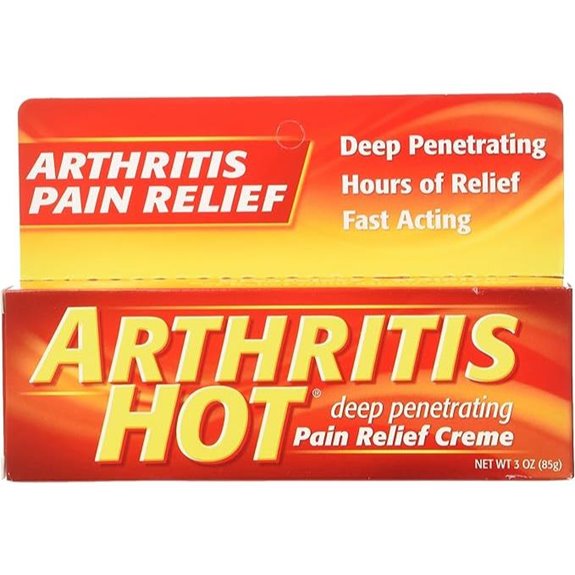 | Fast-Acting Relief | Type: Topical pain relief creme | Active Ingredient Class: Menthol-based (menthol 10%) | Target Pain Areas: General arthritis/muscle pain (joints/muscles) | VIEW LATEST PRICE | Read Our Analysis |
| Diclofenac Gel Twin Pack for Arthritis Pain | 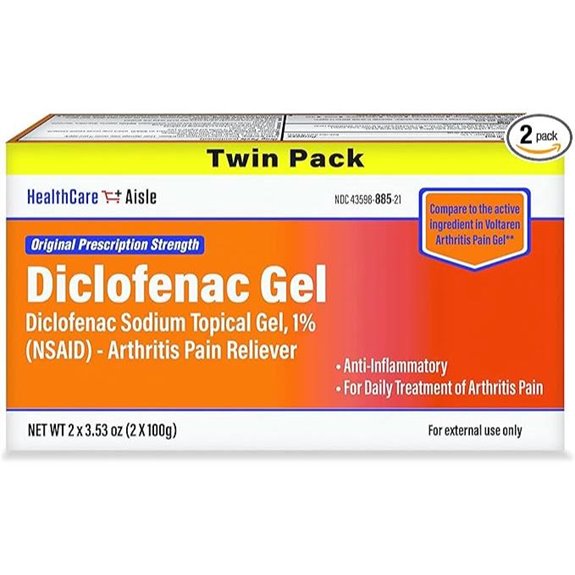 | Doctor-Trusted NSAID | Type: Topical NSAID gel | Active Ingredient Class: Diclofenac sodium (NSAID) | Target Pain Areas: Arthritis pain in hands, wrists, elbows, feet, ankles, knees | VIEW LATEST PRICE | Read Our Analysis |
| Amazon Basic Care Diclofenac Gel 1% 5.29 oz | 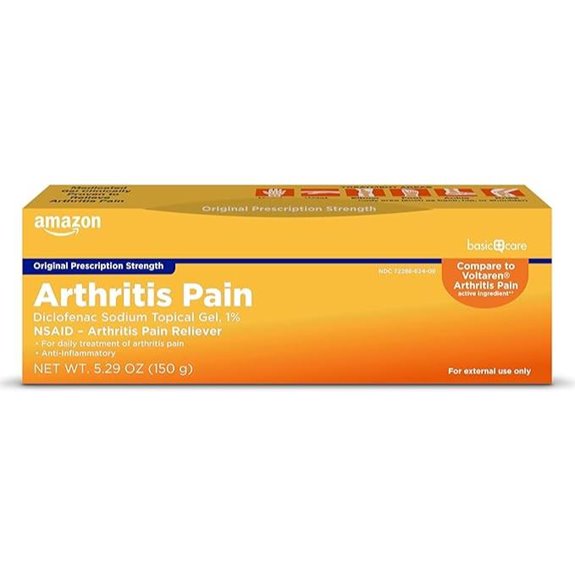 | Clinically Proven Gel | Type: Topical NSAID gel | Active Ingredient Class: Diclofenac sodium (NSAID) | Target Pain Areas: Arthritis pain in hands, wrists, elbows, feet, ankles, knees | VIEW LATEST PRICE | Read Our Analysis |
| Arthritis Pain Relief Lotion with Frankincense & Myrrh | 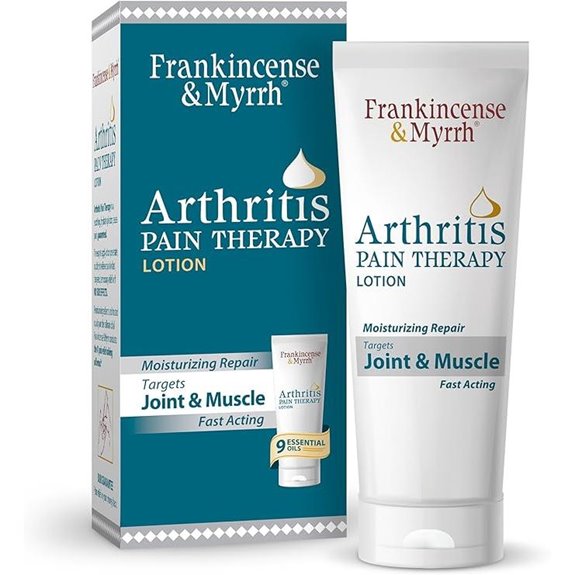 | Premium Hydrating Therapy | Type: Topical pain relief lotion/cream | Active Ingredient Class: Menthol-based blend (aromatics) plus active calming ingredients | Target Pain Areas: Arthritis/pain in joints, muscles (hands, wrists, elbows, knees, etc.) | VIEW LATEST PRICE | Read Our Analysis |
| Amish Origins Arthritis Pain Relief Cream (3.5 oz) | 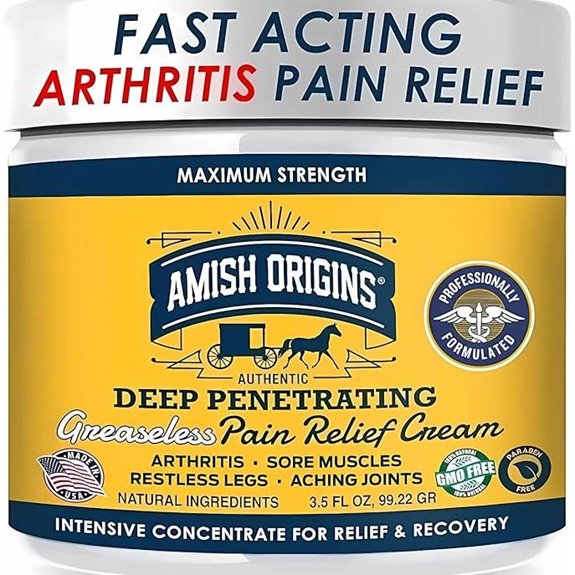 | Deep-Penetrating Strength | Type: Topical pain relief cream | Active Ingredient Class: Proprietary natural blend (not explicitly NSAID; noted as deep-penetrating pain relief) | Target Pain Areas: Arthritis, joint, and various pains (general) | VIEW LATEST PRICE | Read Our Analysis |
More Details on Our Top Picks
Arthritis Pain Relief Creme with Menthol (Pack of 6)
The Arthritis Pain Relief Creme with Menthol (Pack of 6) is a strong pick if you want fast-acting, portable relief for arthritis and muscle pain on the go, thanks to its 10% menthol formulation and triple-application guidance. You apply this topical creme by massaging into the affected area until absorbed, repeat up to 3–4 times daily if needed, and carry it with you for convenient use anywhere. Suitable for adults and children over 12, it targets joint and muscle discomfort quickly. Each item includes a 3-ounce tube; follow directions and wash hands after contact. Do not exceed recommended applications.
- Type:Topical pain relief creme
- Active Ingredient Class:Menthol-based (menthol 10%)
- Target Pain Areas:General arthritis/muscle pain (joints/muscles)
- Application Size / Pack Size:3 oz (pack of 6)
- Usage Frequency / Guidance:Up to 3-4 times daily
- Special Notes / Warnings:For adults and children over 12; avoid hand residue contact
- Additional Feature:Portable on-the-go size
- Additional Feature:Menthol 10% formulation
- Additional Feature:For adults and 12+
Diclofenac Gel Twin Pack for Arthritis Pain
If you’re seeking an affordable, over-the-counter option that matches the active ingredient of the name-brand gel, the Diclofenac Gel Twin Pack from HealthCareAisle is a strong pick for arthritis pain relief. This 1% diclofenac sodium topical gel comes in a 200-gram twin-pack (2 x 100 g), designed for temporary relief of arthritis pain in hands, wrists, elbows, feet, ankles, and knees. It’s a non-steroidal anti-inflammatory gel, clinically proven to relieve pain at the source and comparable to Voltaren Arthritis Pain Gel. Use up to 21 days as directed; follow the package label and warnings. Eligible for HSA/FSA.
- Type:Topical NSAID gel
- Active Ingredient Class:Diclofenac sodium (NSAID)
- Target Pain Areas:Arthritis pain in hands, wrists, elbows, feet, ankles, knees
- Application Size / Pack Size:200 g total (2 x 100 g)
- Usage Frequency / Guidance:Use up to 21 days unless directed
- Special Notes / Warnings:Not manufactured by Voltaren distributor; follow label warnings
- Additional Feature:Unscented topical gel
- Additional Feature:HSA/FSA eligible
- Additional Feature:OTC since originally prescription
Amazon Basic Care Diclofenac Gel 1% 5.29 oz
Designed for arthritis sufferers who want a straightforward NSAID option, Amazon Basic Care Diclofenac Gel 1% (5.29 oz) delivers targeted relief with 1% diclofenac sodium. You apply this topical gel to arthritis-affected areas, such as your hands, wrists, elbows, feet, ankles, or knees. The active ingredient, diclofenac sodium 1% (0.93% diclofenac), is an NSAID meant for temporary relief of arthritis pain. Use it up to four times daily, on no more than two body areas, for up to 21 days unless your doctor directs otherwise. It may take up to seven days to feel full relief; clinical relief is expected with consistent use. Packaging varies.
- Type:Topical NSAID gel
- Active Ingredient Class:Diclofenac sodium (NSAID)
- Target Pain Areas:Arthritis pain in hands, wrists, elbows, feet, ankles, knees
- Application Size / Pack Size:5.29 oz (150 g)
- Usage Frequency / Guidance:Apply 4 times daily; up to 21 days unless directed
- Special Notes / Warnings:See labeling; NSAID guidance; may take up to 7 days to work
- Additional Feature:150-gram size
- Additional Feature:Clinically proven relief
- Additional Feature:4x daily application
Arthritis Pain Relief Lotion with Frankincense & Myrrh
Arthritis Pain Relief Lotion with Frankincense & Myrrh stands out for those seeking fast-acting relief with hydrating skin repair in a single 3 oz tube, suitable for adults and children 12+. You target hands, wrists, elbows, knees, feet, ankles, neck, and back, enjoying quick penetration and targeted relief for inflammation, overuse, stiffness, or soreness. This lotion blends lanolin, shea butter, cocoa butter, menthol, and nine calming essential oils, offering a rich scent and hydrating skin care. It’s produced in the U.S., FDA-registered, and endorsed by many clinicians. Use per directions; results vary by condition and pain type.
- Type:Topical pain relief lotion/cream
- Active Ingredient Class:Menthol-based blend (aromatics) plus active calming ingredients
- Target Pain Areas:Arthritis/pain in joints, muscles (hands, wrists, elbows, knees, etc.)
- Application Size / Pack Size:3 oz (1 pack)
- Usage Frequency / Guidance:Apply as needed; fast-acting guidance
- Special Notes / Warnings:FDA-registered facility; clinician endorsement; may vary in efficacy
- Additional Feature:FDA-registered manufacturing
- Additional Feature:Fragrance from essential oils
- Additional Feature:Clinician-endorsed by 3,000+ professionals
Amish Origins Arthritis Pain Relief Cream (3.5 oz)
For those seeking fast, deep relief without greasiness, Amish Origins Arthritis Pain Relief Cream (3.5 oz) stands out as a top pick in 2026’s best arthritis creams. You’ll apply a small amount to the aching joint, back, knee, or other sore areas. This unisex formula delivers quick-acting relief, with deep penetration and long-lasting soothing effects, without a greasy residue. It targets arthritis, achy joints, sore muscles, bruises, sprains, and headaches, offering rapid relief that absorbs quickly. The 3.5 oz size is convenient, and the cream’s easy application supports regular use for ongoing comfort. Experience smoother joints and renewed mobility fast.
- Type:Topical pain relief cream
- Active Ingredient Class:Proprietary natural blend (not explicitly NSAID; noted as deep-penetrating pain relief)
- Target Pain Areas:Arthritis, joint, and various pains (general)
- Application Size / Pack Size:3.5 oz
- Usage Frequency / Guidance:Quick-acting relief; duration unspecified (usage implied as needed)
- Special Notes / Warnings:Efficacy varies by individual; not a guaranteed result
- Additional Feature:Maximum Strength deep penetrating
- Additional Feature:Unisex formulation
- Additional Feature:Deep penetrating, non-greasy
Factors to Consider When Choosing Arthritis Pain Relief Cream
When you choose an arthritis pain relief cream, start by checking the ingredient spotlight to spot active pain-relief compounds and potential allergens. Consider how you’ll use it, including application guidelines and the target area range, so you pick a formula that fits your joints and routine. Also weigh onset and duration plus safety considerations to balance quick relief with long-term safety.
Ingredient Spotlight
Curious about what to look for in arthritis pain relief creams? Here’s the Ingredient Spotlight you need. Menthol-containing creams give you an immediate cooling sensation and temporary numbness, which can boost perceived relief. Diclofenac topical gels deliver NSAID-based relief that targets inflammation at the source, often used for arthritis pain. The percentages listed—menthol at 10%, diclofenac at 1%—signal the active ingredient concentration driving the main analgesic or anti-inflammatory effect. Gel formulations target joint and muscle pain with a non-greasy, quick-absorbing texture, while creams and lotions may emphasize deeper skin penetration or moisturizing benefits. Over-the-counter options sometimes specify usage windows, such as up to 21 days or 3–4 applications daily, underscoring the need to follow per-label dosing.
Application Guidelines
To choose arthritis pain relief cream wisely, follow the product’s directions—apply as labeled (up to 3–4 times daily) and avoid using on broken skin beyond the recommended areas. You’ll get the best relief when you massage the cream into the affected area until it’s fully absorbed. This helps with penetration and comfort. Check age restrictions and safety notes, such as whether it’s for adult use only or suitable for children above a certain age. Adhere to application limits, including how many body areas you can treat or how long you should use it (for example, 21 days unless a doctor advises otherwise). Wash your hands after applying if the product contacts them, and avoid applying to irritated or broken skin.
Target Area Range
Choosing the right target areas is essential for effective relief, so look for creams that specify exact joints or regions—hands, wrists, knees, ankles, or elbows—that match where you hurt. Look for products that clearly mark the intended targets, which helps you apply the right amount to the right spots without guesswork. Some creams are formulated for both upper body (hands, wrists, elbows) and lower body (feet, ankles, knees), broadening usable areas. Consider whether the product lists multiple joint or muscle targets beyond arthritis, such as back, neck, or sciatic-related pain, since that can influence where you’ll apply it. The range of targeted areas may influence how many applications or amount you need for comprehensive relief. If it emphasizes daily use across several regions, it may suit widespread discomfort.
Onset and Duration
Onset and duration matter, because you want relief when you need it and for as long as you’re active. Cookies of topical options vary: some creams promise rapid relief, others may take several days to show significant improvement. Duration ranges from a few hours to all day, depending on the active ingredients and formulation. Many products limit applications to 3–4 times daily to prevent overuse, even if they work quickly. Topical NSAID creams, like diclofenac 1%, offer moderate source relief but often require consistent daily use for best results. For certain formulations, relief may be limited to hands, wrists, knees, feet, ankles, or elbows, and noticeable gains may take up to a week for some users.
Safety Considerations
Have you checked safety first? Start by reading the label for age suitability, since many topical arthritis products exclude children under 12. Check active ingredients and potential allergens, like menthol 10% or diclofenac 1%, to assess allergy risk and drug interactions. Note the maximum daily usage and total treatment duration, such as up to 21 days or 3–4 applications daily, to avoid overuse. Be aware of warnings about skin contact, flammability, and avoiding broken skin or open wounds. Consider NSAID-containing gels (like diclofenac) only if appropriate for your pain type and existing medical conditions, and review whether the product is OTC or requires a prescription. Prioritize products matching your medical profile and follow labeled directions carefully.
Gel Vs Cream
When deciding between gel and cream for arthritis relief, consider how you want the product to feel and how quickly you need relief. Gels absorb fast and leave a light feel with less residue, so you’ll dry off quickly and stay active. They deliver topical NSAIDs like diclofenac effectively to joints, but may require more frequent reapplication due to evaporation. Creams are thicker, offering longer-lasting moisture and deeper hydration for surrounding skin comfort, which helps if your skin feels dry from repetitive use. With menthol or essential oils, creams can provide a cooling sensory boost, while gels focus on delivering the active ingredient. For sensitive skin or fragrance concerns, gels tend to be preferable, though creams provide richer moisturizing properties overall.
Compatibility & Accessibility
Choosing the right arthritis relief cream goes beyond how it feels on the skin; you also need to contemplate how easy it is to access and use. First, check whether the product is over the counter or prescription, since this affects accessibility and cost. Next, confirm packaging size and total amount—3 oz tubes, larger tubes, or twin packs—to gauge how long it lasts and where you can buy it. Look for FSA/HSA eligibility to determine if reimbursement is possible. Verify labeling for usage limits, such as maximum daily applications or total days of use, so it fits your routine safely. Finally, assess the active ingredients (diclofenac gel versus menthol-containing cream) to align with your treatment preferences and any allergies.
Common Questions
How Do These Creams Interact With Oral NSAIDS or Prescriptions?
Yes, you can generally use topical arthritis creams alongside oral NSAIDs, but check ingredients and talk to your doctor to avoid duplicating NSAID effects or masking serious symptoms. Some creams contain NSAID ingredients, so avoid taking extra tablets. If you have prescriptions, coordinate with your clinician before combining therapies to prevent interactions. Also watch for skin irritation, allergy signs, or reduced effectiveness of oral meds. Report unusual effects right away.
Are There Any Long-Term Safety Concerns With Frequent Use?
Yes, there can be long-term safety concerns with frequent use. You might develop skin irritation, thinning, or allergic reactions, especially if you’re sensitive to NSAID or menthol ingredients. Prolonged reliance could mask underlying issues, delaying proper care. Overuse can cause systemic absorption in larger areas or with broken skin. Always follow label directions, limit continuous use, and consult your clinician if symptoms worsen, you’re pregnant, or taking other meds. Consider non-pharmacologic options too.
Do They Require a Doctor’s Note for Purchase or Use?
No, you generally don’t need a doctor’s note to buy or use arthritis pain relief creams. They’re over-the-counter for topical relief, though some prescription formulations require a clinician’s guidance. Think of it like any other OTC product: follow directions, watch for skin reactions, and avoid applying on broken skin. If you have medical conditions or take other meds, check with your doctor or pharmacist to be safe, and don’t exceed recommended use. Simile: like a trusted pocket map guiding you through pain.
Can These Creams Be Used on Sensitive Skin or by Children?
Yes, you can use many of these creams on sensitive skin or by children, but you should check ingredients first and do a patch test. Look for fragrance-free formulations and avoid harsh additives. Start with a small amount on a discreet area, wait 24 hours, and monitor for irritation. Consult a pediatrician before using on kids, and talk to your pharmacist if you have allergies or take other medications. If in doubt, stop use and seek guidance.
Which Formulations Are Best for Nerve-Related Arthritis Pain?
For nerve-related arthritis pain, look for formulations with menthol, capsaicin, lidocaine, or nonsteroidal anti-inflammatory ingredients, plus soothing carrier oils. Capsaicin creams may require gradual buildup and can sting initially. Lidocaine provides targeted numbing, while NSAID gels help reduce inflammation where nerves flare. Try combinations that suit sensitive skin, and patch-test first. Start with low concentrations, monitor results over a couple weeks, and consult a clinician if pain persists or tingling worsens.